💬 Thoughts 📖 Posts 📡 RSS

Burning The Candle On A Third End

Hey Folks!

Because my brain decided I didn’t have enough going on already (and a healthy dose of thinking “wow, that’s a good idea” when Cherish mentioned it to me), I’ve started EngineerBlogs.org with a couple other engineer bloggers! I’ve already mentioned it on Twitter, but I thought I should write about it here as well.

The lineup right now is me, Cherish, Fluxor and FrauTech.  But we’re looking for more! If you’re interested, check out the “Write For Us” page on the site and fill out the form there. We have some requirements, but if you’re a good writer and have been doing it for a little while, we’d love to hear from you.
So Chris, Where Have You Been?

Well,  a lot of places.

But not around here too much. And when I’ve been here, it hasn’t been the most in-depth writing I’ve ever done (except my unusually thought out post comparing engineers to a fictional character, check that out if you haven’t, not many people noticed it). I can’t say I will be writing again full time in the near future, but maybe in the future after that. So here’s a quick rundown of where I’ve been and what I’ve been doing if you don’t already know:

Makeshift Current Sink

I’m working on a new switcher design and need to be able to test the total current coming out of a boost converter. Here’s what I’m looking at:

  • 0-60V rails (out of the boost converter)
  • 0-350 mA
  • No access to the load that will eventually be connected to the switcher

So what do I need? I need something that can sink current and dissipate any heat that will be generated. If the load is dropping the entire voltage at the top current, that will be:

Fast Design

I’m finally starting to get it.

Apparently in the past the design work I’ve been doing is too slow. It’s too methodical, I have too much time to question my decisions. Well not anymore.

I’ve been working on a time sensitive project recently (sensitive enough that I feel bad writing this post at 9 pm on a  Saturday) and I’ve finally started to understand the reason the part vendors come to talk to me about power module this and fast design that. They come in with these nearly-done solutions and try pushing them on me, only to hear me say something like,  “Wow, I’d never use that”. I mean, where is the fun in using a power switcher that is damn near complete?

The Engineering Model Of The Future: Malcolm Reynolds

“Wha?”

That’s what you said when you read the title, isn’t it? That’s probably what I would have said. You said that for one of two reasons:

  1. You’ve never watched Firefly.
  2. You’ve watched Firefly and you just don’t get it yet.

The second is more excusable than the first. If you’ve never watched Firefly, I highly suggest going to do that right now. It’s 14 episodes (one season) and a feature length film. It’s a great show that was unfortunately cancelled after one season.

The Rock Stars of Analog

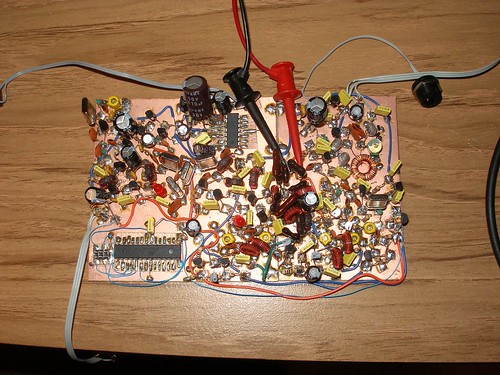
Over on The Amp Hour, I’ve been known to call ham radio operators, “The Rock Stars of Analog“. This is meant for the ones that are out there making their circuits using the dead bug method or otherwise. Jason Milldrum from NT7s.com has confirmed this belief with a picture in his latest posting about his RF kit making business:

Project X Prototype

I mean would you LOOK at that thing??? It’s awesome! Plus it transmits radio signals, so it’s just that much more magical. I know the theory behind RF, but I still geek out whenever I think about radio stuff. Anyway, thanks to Jason for posting the picture on his site and on Flickr. Check out his blog for more info as it comes available!

What Is A Power Budget?

Boy is it hot in here or is it just me? Why’s that gizmo over there giving off so much heat?

Power budgets are a necessity these days. Due to increasing regulation, we’re seeing devices that must comply with efficiency limits in their power conversion (using a switching power supply or otherwise).

So what is a power budget? Much like a budget you might have for your personal finances, a power budget shows where all the possible power will be used by a device to by breaking it down into components and categories. In some situations, you might be told up front that you will have 3W available to run your design. However, sometimes as designers we start by calculating the total power a system needs and then taking actions such as replacing parts or redesigning circuits to cut back power to an acceptable level. So why might someone want to do a power budget from day one?

Homeschooling

I have lots of thoughts about education, especially higher education. The theme that keeps popping up in my head though is that school isn’t too far removed from teaching yourself. Honestly, let’s look at the learning process:

  1. Encounter a “problem” that needs to be solved.
  2. Do background research and look at past examples of how it was solved.
  3. Apply your newly gained knowledge to the problem at hand.
  4. If a new problem arises that is not encompassed by the recently acquired wisdom, go back to step 2.
  5. Report on your findings to others.

Doesn’t this sound like work? Or studying on your own? Or doing a hobby project? How is this any different?

They Don't Make ‘Em Like They Used To!

Being an analog engineer, I’m around “more experienced” engineers on a daily basis. However, a group of younger engineers often find ourselves acting much older than we are, shouting things like “Get off my lawn!” and “Back in my day…” (really, we had a whole list).

Anyway, another common one that comes up is “They don’t make ’em like they used to!”.  Do we as engineers know WHY they don’t make them that way anymore? Of course we do. The lower reliability and requirements for many more people to assemble the devices honestly doesn’t make sense these days. With lower priced labor the world over and low tolerance for waste and inefficient processes, I know I wouldn’t make the proverbial “them” that way anymore. It just doesn’t make sense.

Recruiting In An Emerging Age Of Makers

I’ve started reading resumes from the bottom up.

What does this mean? It means I’m looking for passion. It means I’m looking for interest. It means I look for people who do electronics for fun. It means that classroom experience–while important–is not getting you the job. In fact, quite the opposite. If you’re spending all of your time in the classroom, how useful are you? Yes, understanding the basics are important. But if you’re going to quote me an equation you learned instead of going out and soldering and desoldering components to a board, how will I know that you’re a legit worker that is willing to get their hands dirty? (solder-y?)