💬 Thoughts 📖 Posts 📡 RSS

What The World Needs, Part 1

I like the communication between myself and my readers and my readers (either random or regular) on the comments section. As such, I’ve decided to try some posts titled “What the world needs” (similar to the “My Hobby” posts over at xkcd). These will supplement, not supplant, my regular posts. So here we go:

What the world needs, part 1…

What the world needs is more energy storage solutions. What we have right now just isn’t going to work. Batteries aren’t reliable enough over the long term, ultracapacitors aren’t developed enough and large scale solutions just aren’t efficient enough. All we keep hearing about at the Detroit auto show are the hybrid and plug-in vehicles (Nov 2010 for the Volt? It’s going to take that long??). While they have the conversion from braking energy back into stored energy, I feel like all of the stored energy solutions right now (within the cars, just are not sufficient). Furthermore, when all those plug-in vehicles are in the driveways of the suburbs and sucking down grid power, there will be a higher need to draw upon reserves of energy, either by cranking on more power plant capacity or tapping stored energy. If we want renewable energy to fill that gap in available power we will need even more storage capability, as renewable sources are not “always on”.

Yes, I'm still here

It’s 2009.

More importantly I’m still employed. I actually had a blog post planned out for early January in the event that I lost my job. Hey, if you’re not going to promote yourself, who will?

I was reviewing my new years resolutions from last year and I realized the only one I really followed through on was finding new employment. And since finding my new employment and starting a blog and all of those details, I have come to some important realizations, mostly about work:

Happy Holidays

I’ve been a bit more of a Grinch this year than I am usually at Christmas/Festivus/Hanukkah/Kwanzaa/etc. I think part of it is my worries about the economy and the rest is because I think the buying of presents is good intentioned, but kind of a waste. Once I get past my own soapbox, I often find that I end up with some thoughtful gifts from the ones I love. Let’s get to the part where I am thankful for the gifts I did get:

A Quick Thought on the Economics of Renewable Energy

I glanced at my natural gas bill today while cleaning up the house and was a little shocked at myself. I pride myself on being better than most on conservation (at least cognizant of it) and my usage was quite high. That was last month and I can only imagine this month will get worse. And yes, I do live in a rental house right now (with an energy efficient house in my near future), but that’s the case for a lot of people, especially lower income. So I got to thinking, what will stop people from using so much energy in their frosty, great northern homes?

Designing For The Long Term

I was at the gym the other day and glanced over at a fellow gym-goer on their cellphone. I did a triple take as the phone was a flip phone that was maybe 4 inches wide and 5 inches high on each flap of the flip (making a 10 inch phone when completely extended).  On my third glance at this monstrosity of a phone I realized it was in fact a Blackberry that he had pulled out of it’s case/holder but the case looked like the bottom half of a flip phone. It got me thinking about design longevity.

Circuit Board Design (And How It Has Changed)

Products today mostly use Printed Circuit Boards (or PCBs) to successfully route signals from one component in a circuit to the next. There are multiple layer circuit boards with printed metal “wires” that run between the various elements in a circuit. However, this was not always the case. In the good ol’ days, there were different variations and precursors to the PCB. Some of these included point to point wiring (just soldering a wire between say a resistor and a capacitor), wire wrap boards (think of a point-to-point board on a grid with more wires than you’d know what to do with), acid etched copper on dielectric (think of a 1 layer PCB with very large and rounded signal traces) and many others. These kinds of boards had many many different methods but also had less restrictions than modern designs. In fact,  Paul Rako from EDN recently wrote a great article on prototyping using some of these older methods. He references many techniques of the greats like Bob Pease and Jim Williams and their rapid prototyping techniques. It’s an information rich article and I would highly suggest checking it out. OK, back to the party.

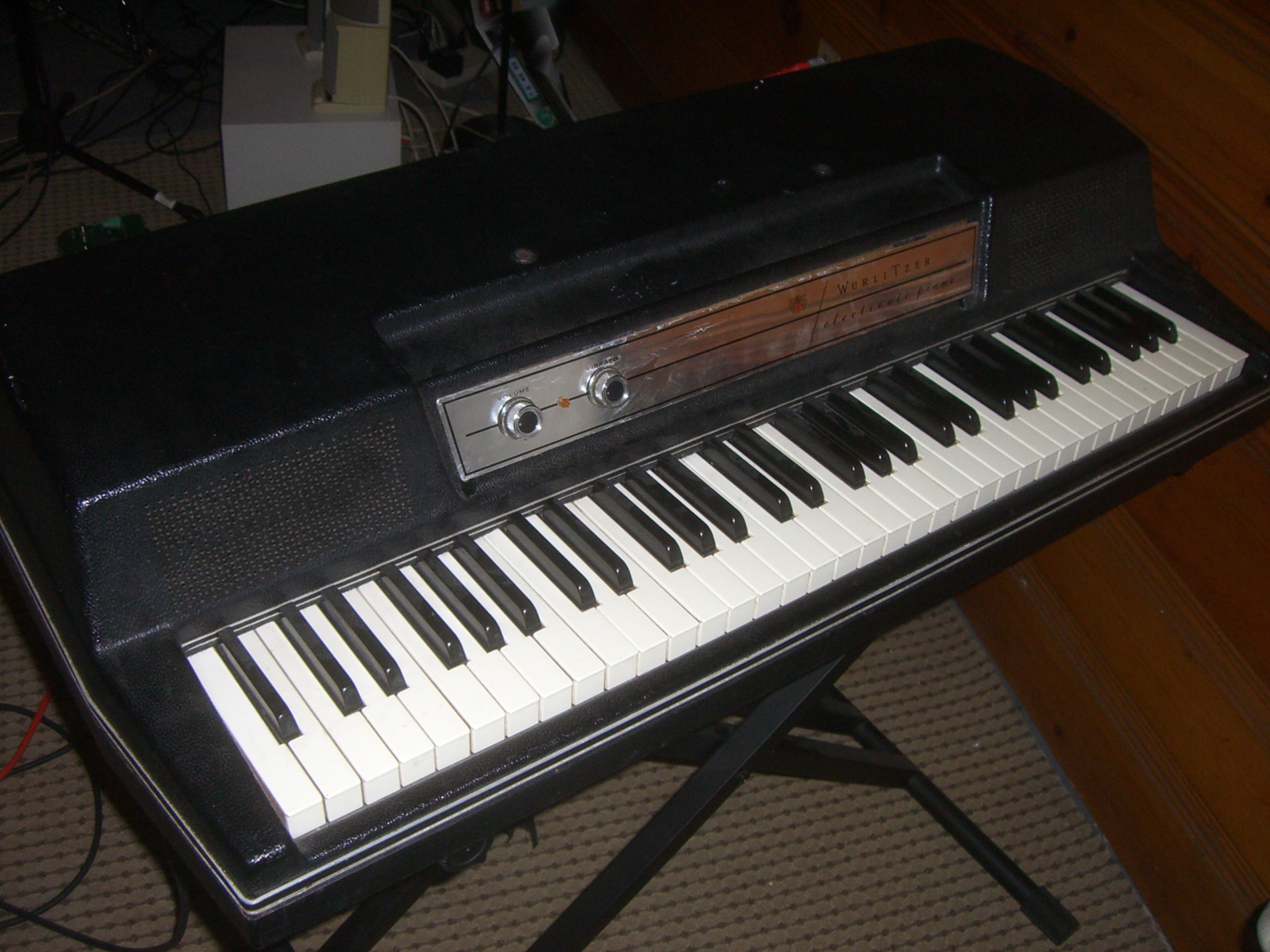
Update: Wurlitzer 200A–Still in pieces

I thought I would update on my hobby subject for tonight since I mostly worked on my Wurlitzer 200A electric piano instead of writing the post I meant to. I’m just now getting back into working on my electric piano after previously having zapped something on the board and not being able to get it working since. When I messed up last time I was actually trying to replace the capacitors and transistors that had dried up; I had thought these were causing considerable hum in the circuit. However, since deconstructing the piano I found a modification to the wiring scheme between the two speakers and the output headphone jack located at the bottom of the board. I found that on the headphone jack someone had wired in a simple RC circuit, presumably for filtering the headphone output. However, the small wiring scheme they used and meant to ground to the chassis had been disconnected, possibly by me. This floating output circuit could have been the problem all along! Only time will tell but I will feel silly if that was indeed the culprit.

Cheaper than Coal?

My friend Cherish over at Faraday’s Cage is where you put your Schroedinger’s Cat sent me an article on solar power approaching the cost of coal (generated electricity). It’s a great article and it quotes Ray Kurzweil so I’m automatically a fan. However, I have no doubt in my mind that it WILL hit this price point (~$1/watt), it’s just a question of when.

The real thing I want to touch on and get responses to is: What happens when solar energy is cheaper than coal?

Best Free SPICE Program

One of the biggest conflicts of interest in the life of an analog engineer is that the best tool available to them is on a computer. SPICE is a program that was originally developed at Berkley to model silicon level physics to help prototyping (similar to “bread-boarding”) before the final product was produced. While it still remains a valuable tool for chip designers, it has also been broadened in scope and size to include larger designs and higher level models since it was first created. The idea is the same, that electrons basically move in the same way and that potentials in a circuit (voltages) can induce a certain behavior. So as long as the models for high level components (say an op amp or a buck converter) are well thought out, they often can represent the real world equivalent quite well.

Frank Jackson Pushing For Renewable Energy In Europe

A quick note to share what I heard this morning on NPR and thought is relevant to…well…me really. But you too if you live in Cleveland and are interested in renewable energy.

Frank Jackson, mayor of Cleveland, is in Germany this week, drumming up business to move to the US, specifically Cleveland and most specifically, in renewable energy. This is great news for the region because it could help bring back some manufacturing jobs (especially skilled manufacturing, as required by solar). Aside from more reasonable wages the US can offer  to businesses thanks to the recession we’re currently in, Jackson is pushing the research capabilities at Case Western Reserve University and other local schools. He is also citing Cleveland’s strong infrastructure that could be critical to moving product within this country by rail, truck or plane. Add to that the cultural amenities of the region and it starts to look like many of the reasons I moved back here. The trip was financed by the Cleveland Foundation, a great local charity that pushes for more development in the region.